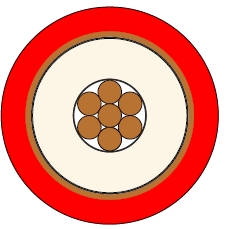
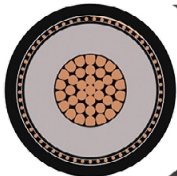
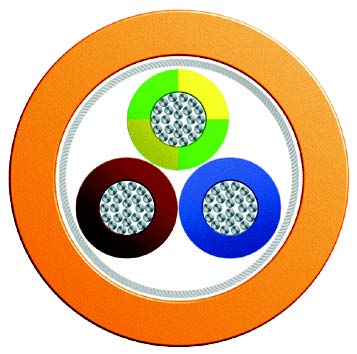
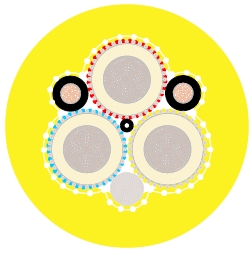
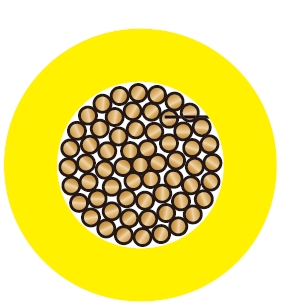
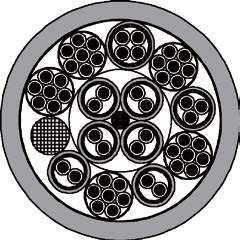
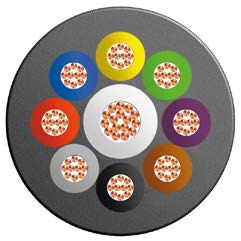
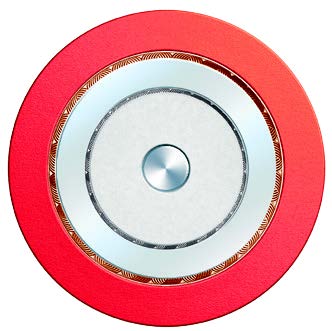
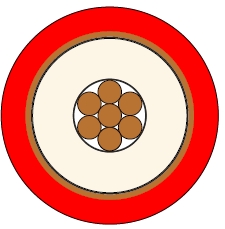
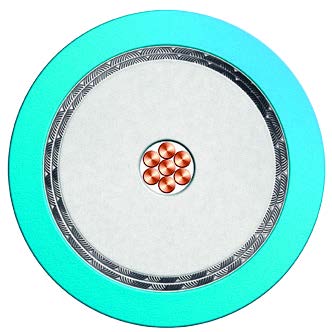
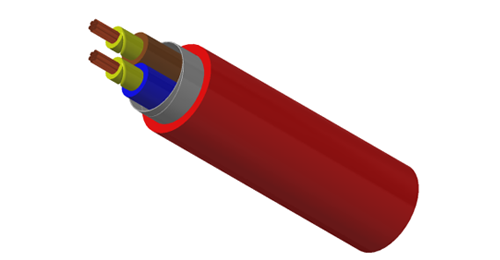
CT100 is a 75 ohm coaxial cable for television reception and other compatible signal-distribution circuits. A 1.00 mm bare copper centre conductor sits within foam PE dielectric, with copper foil and bare copper braid forming the two screening layers. The construction lists PVC or LSOH outer sheath options and a nominal overall diameter of 6.55 mm. The attenuation and return-loss data help match the cable to the required frequency band and route length.
Inner conductor | Bare copper | Φ1.00 mm |
Dielectric | Foam PE | Φ4.60 mm |
Outer conductor (shield 1) | Copper Foil | Φ4.75 mm |
Shield coverage 1 | Φ100% | |
Outer conductor (shield 2) | Bare copper braid | 96x0.10 mm |
Shield coverage 2 | 55% | |
Sheath | PVC/LSOH | Φ6.55 mm |
Impedance | 75±5 Ohm |
Nominal capacitance | 50 pF/m |
Velocity of propagation | 85% |
Insulation resistance | >5000 Mohm.Km |
Inner conductor resistance | 21.4 Ohm/Km |
Outer conductor resistance | - Ohm/Km |
Rated temperature | 70°C |
Operating voltage | 30 V |
Cable weight (approx.) | 57 kg/km |
Screening effectiveness | >75 dB (30-1000MHz) >65 dB (1000-2150MHz) |
Frequency(MHz) | Attenuation (dB/100 m) | Attenuation (dB/100 ft) |
50 | 4.6 | 1.4 |
100 | 6.5 | 1.98 |
200 | 9.5 | 2.9 |
460 | 15 | 4.57 |
860 | 19.5 | 5.95 |
1000 | 21.5 | 6.55 |
1750 | 29 | 8.84 |
2150 | 32.5 | 9.91 |
5-470 MHz | >23dB |
470-860 MHz | >20dB |
860-2150 MHz | >18dB |
75±5 ohm impedance and 50 pF/m nominal capacitance.
Copper foil screen with a separate bare copper braid.
Attenuation data listed at frequencies from 50 to 2150 MHz.
Select the sheath material and connector size for the actual route. Include splitters, joints and connectors when checking the signal-loss budget. Where outdoor exposure or burial is intended, specify those conditions for assessment rather than choosing solely by the CT100 designation. Confirm any receiver-supply voltage against the listed 30 V operating value and the connected equipment.
CT165 Coaxial Cable, 75 Ohm, Foam PE and Dual Copper Screens
RG59 Armoured Coaxial Cable, 75 Ohm, Foam PE and LSZH Sheath
What is the nominal cable diameter?
CT100 is listed with a 6.55 mm nominal overall diameter.
What forms the two screens?
The construction uses copper foil and bare copper braid around the foam PE dielectric.
How does it compare with CT125 and CT165 at 1000 MHz?
The listed losses are 21.5 dB/100 m for CT100, 17 dB/100 m for CT125 and 13.5 dB/100 m for CT165. Their diameters also differ.
Which sheath should be ordered?
State PVC or LSOH to match the installation and required fire-performance documentation.
Does the table through 2150 MHz set a universal reception distance?
The permitted length depends on signal levels, equipment requirements and all losses in the installed route.